venerdì 5 luglio 2013

Bridal Tiaras in the British Royal Family, Part I

So, tiaras being one of my favourite subjects (ah!), today we take a closer look at tiaras worn by British royal brides over the decades, beginning, with a slight historic inaccuracy, with Queen Elizabeth's Strathmore tiara, which wasn't worn exactly on her wedding day, but was indeed a wedding present, and it's a particular favourite of mine, I feel justified in adding it to this list!


The highly informative The Queen's Diamonds book by Hugh Roberts, Surveyor Emeritus of The Queen's Works of Arts, reveals that the tiara is late nineteenth century and made up of pavé-set diamonds, mainly rose-cut in silver-gilt on a gold frame, that form a garland of wild roses.

Technical details aside, the tiara was famously given to the then Lady Elizabeth Bowes-Lyon by her father, the Earl of Strathmore, on her marriage to the Duke of York (later King George VI) in 1923.
Hugh Roberts informs us that "the tiara was retailed by the jewellers Catchpole & Williams, of 510 Oxford Street, and was supplied with two alternative frames, one invisible (for wear as a bandeau over the brow), the other padded (for wear on the head). It could also be dismantled to form five individual brooches", which apparently could be substituted with single sapphires.

When Duchess of York, Queen Elizabeth was photographed a number of times wearing her tiara in the 1920s style, fashionably low over her forehead.

Although it was inherited by the Queen on the Queen Mother's death in 2002, this piece has not been worn since (nor, indeed, it had been worn in public for many decades since its early days).

 
Fast forward a few years, and here comes Princess Elizabeth's wedding to Prince Philip in 1947.
For her "something borrowed", the woman who was to become Queen in a matter of years choose Queen Mary's Fringe tiara, a 1919 piece by E. Wolff & Co. for Garrard & Co.
 
 
The jewel was originally made especially for Queen Mary, in the Russian style which was especially fashionable at the time (Tsarina Alexandra had had a tiara in exactly the same style, reminiscent of the traditional Russian headdress kokoshnik).
 
Hugh Roberts reports that in was given in 1936 by Queen Mary to Queen Elizabeth, from whom it was subsequently borrowed by Princess Elizabeth to be worn on her wedding day (and on a number of occasions since she inherited it from her mother in 2002, most famously in one of the Diamond Jubilee portraits).


The it was Princess Margaret's turn, with her marriage to Anthony Armstrong-Jones in 1960. This time the bride choose the Poltimore tiara, a splendidly intricate piece made by Garrard & Co. in 1870 for Lady Poltimore.
 
 
Princess Margaret bought it herself, at auction in 1949 for £ 5,500. Upon her death in 2002, it was auctioned again, together with other pieces in her collection, to help pay estate duties. This time, the tiara sold for £ 926,400, against a top estimate of £ 200,000.
 

The Princess was later famously photographed by her husband while wearing the tiara in the bathtub.


Then, on 14 November 1973, the Queen's daughter Princess Anne married her first husband, Captain Mark Phillips (it should be noted that for her second marriage, to Commander Timothy Lawrence, the Princess Royal opted not to wear a tiara, choosing instead to adorn her hair with a simple sprig of orange blossom, which matched her bouquet and complemented perfectly her cream suit).
 
Anyway, back to 1973...Princess Anne chose a rather unusual, stunning white silk gown in the Elizabethan style, inspired by Tudor court dress (more on the dress itself can be found at The Royal Order of Sartorial Splendor).
 
Nothing new on tiara side this time, though, as Princess Anne got married in Queen Mary's fringe tiara, the same piece her mother the Queen had chosen to wear to her own wedding 26 years earlier.
 
 
I just couldn't resist adding this photo of the bride with her father the Duke of Edinburgh...so beautiful!
Could she have chosen something else, perhaps something more delicate and prettier, in keeping with the fairy tale style of her wedding? She definitely should have, in my opinion...after all, she had a lot of other options to choose from in the extensive British royal family collection: her grandmother's Strathmore tiara would have been a spot on choice, given also its Rose of York motive, which would have complemented perfectly the Tudor theme of the wedding dress.
 
 
To be continued...
 

giovedì 4 luglio 2013

Belgian Tiaras

After the announcement was made yesterday afternoon that King Albert II of Belgium will abdicate in favour of his son later this month, I thought it might be nice to have a closer look at some of the tiaras associated with the Belgian royal family, some of which we might well catch a glimpse of at the upcoming coronation of the new king!

Let's start with Queen Elizabeth's diamond diadem, created by Cartier in 1910. Queen Elizabeth was born a duchess in Bavaria and married Prince Albert, second-in-line to the throne of Belgium, and later became Queen of the Belgians in 1909, upon her husband's accession to the throne following the death of his father King Leopold II.
 
Photo from the Swedish book Kronprinsessan Astrid, 1926, from Wikipedia.


Official portrait to commemorate the wedding of the Queen's daughter Princess Marie-José to Prince Umberto of Italy, 1930, from the book Gioielli di Casa Savoia, Electa, 2002.
 
 
Queen Elizabeth also often wore her diamond bandeu tiara, a very simple geometric Art Deco piece which is nowadays frequently seen gracing the present Queen's head. It can be worn as a necklace as well and was lent by Queen Paola to Princess Mathilde to be worn on her marriage to Prince Philippe in 1999.
 
Princess Astrid and Queen Paola (who is also wearing the meander bandeau, part of the Nine Provinces tiara, as a choker).

A very young Queen Paola, complete with 1960s beehive, and Princess Mathilde on her wedding day.

 
Queen Elizabeth's daughter-in-law Princess Astrid of Sweden, who was Queen of the Belgians as wife of King Leopold III for just over a year between 1934 and her tragic death in a car accident in August 1935, got a number of gifts on the occasion of her wedding to Prince Leopold in 1926.
 
One of them is the rarely photographed Stockholm tiara, so called because it was a gift to the Princess from the people of Stockholm. More on the history of this exquisite Art Deco piece can be found at A Tiara a Day.
 
 
Astrid wore it bandeau-style on the forehead, as was the fashion at the time, while King Leopold's second wife, Lilian, Princess of Rethy, sometimes wore the central, detachable pearl drop as a brooch.
 
Another wedding gift to Princess Astrid was the Nine Provinces tiara, so called from the nine provinces of which Belgium is made up, which has now become a sort of staple for Belgian royal ladies.
 
Made in 1926 by Belgian jeweler Van Bever, it was a gift from the Belgian people. The tiara originally given to Princess Astrid consisted of a meander bandeau, a style which was extremely popular at the time, topped by eleven detachable diamonds on spikes. The Royal Order of  Sartorial Splendor offers an interesting explanation as to why the diamonds are indeed eleven.
 
Princess Astrid wearing the tiara in its original setting, both with...
...and without spikes in this engagement photograph with Prince Leopold.
 
The Princess later had the tiara altered with the addition of diamond arches on top. In this version, the piece has been passed down the generations and been worn by subsequent Belgian Queens.
 

Queen Astrid.


Queen Fabiola wearing the complete piece and the lower part only.
 
Queen Paola.

Queen Elizabeth's daughter, Princess Marie-José, married the Italian Prince of Piemonte in 1930, as mentioned above, and brought with her to Italy a number of tiaras and diadems.
Among them was the pearl and diamond diadem, which she had inherited from Empress Charlotte of Mexico. Princess Marie-José later had it modified to be worn low on the forehead, as was the fashion.
 
Princess Marie-José from the book Gioielli di Casa Savoia, Electa, 2002.
 
She wore it quite often, both before and after her wedding, and even had a pair of matching pearl and diamond earrings made in the late 1920s.


 In a commemorative postcard issued to celebrate the birth of the couple's first son, Prince Victor Emmanuel in 1937, from the book Gioielli di Casa Savoia, Electa, 2002 (as the earrings below).
 
 
The Princess also inherited from the Belgian side of her family a magnificent Fabergé diamond tiara, which, alas, she never wore (more info and a splendidly detailed close-up can be found here):


And an early XIX century parure of turquoise and diamond jewellery which she inherited from her paternal grandmother, the Countess of Flanders. Princess Marie-José later had the necklace broken up and the stones used on a new diadem, which you can see below in a photo from the wonderfully informative book Gioielli di Casa Savoia:
 
 
Fast forward a few years and we find the Belgian Scroll tiara, which is not part of the Belgian royal family collection as such, because it was a gift to Princess Joséphine Charlotte, daughter of King Leopold III and Astrid, from the Société Général, Belgium National Bank, upon her marriage to Prince Jean, then heir-apparent to the throne of Luxembourg, in 1953.


In 1960, the Spanish Wedding Gift tiara came along, a present from the Spanish government to Doña Fabiola de Mora y Aragón on the occasion of her marriage to King Baudouin. It is a wonderfully versatile tiara, which can be converted into many different combinations; moreover, the stones at the centre of each flower can also be interchanged: Queen Fabiola has worn her tiara with rubies, aquamarines and other precious stones.


The piece can also be converted to be worn as a necklace, as shown below:


One of the most modern additions to the Belgian royal family tiara collection, and one of the most frequently seen, along with Queen Elizabeth's diamond bandeau tiara, is the Laurel Wreath tiara. The piece itself is rather old, having been made by London jewellers Hennel & Sons in 1912, but it made its entrance into the Belgian collection in 1999, when it was presented to Princess Mathilde upon her wedding to Prince Philippe. This tiara, too, can be worn as a necklace, an arrangement most famously seen on the Princess at the Duke and Duchess of Cambridge's wedding in 2011.


And last of all, when Princess Claire married King Albert's second son, Prince Laurent, in 2003 she received as a wedding gift from the King and Queen a lovely, delicate diamond tiara.
 
Princess Claire has also been photographed wearing another tiara, a diamond scroll with pearls, a much prettier piece than her wedding tiara in my opinion. Mad Hattery! reckons it was bought especially for her.
 

So, that's it, a roll call of tiaras in the Belgian royal family, by no means complete or defintive, but much fun to put together nonetheless! My own personal favourite, the one I'd wear absolutely every day if I had the chance (well, a girl can dream...) is Queen Elizabeth's diamond diadem, so I'll leave you with one final photo of this beauty.

What about you, have you got a favourite? Be sure to leave a comment and let me know!


lunedì 1 luglio 2013

Royal Baby Nail Mania!

With the birth of the Duke and Duchess of Cambridge's only days away now, royal baby mania is beginning to take hold the world over and souvenirs and memorabilia are already filling the shops!

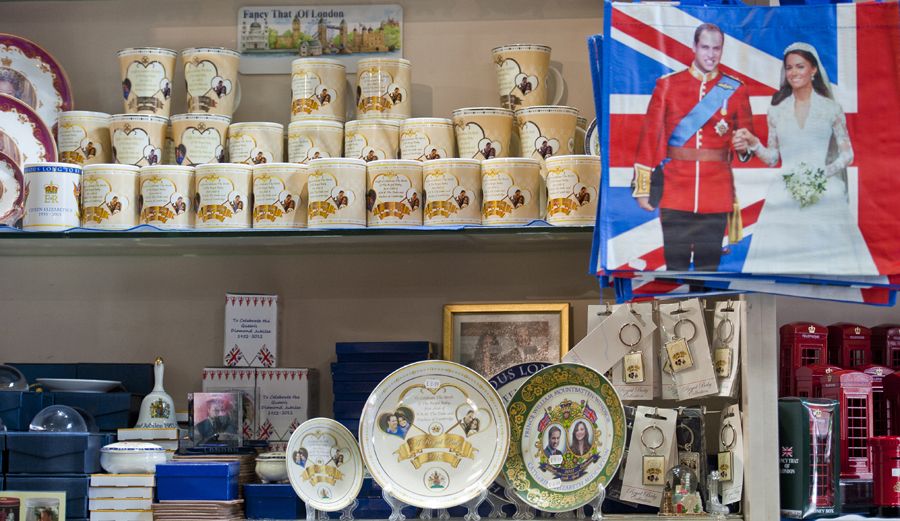
There's the usual array of mugs and china, of course, with a dedicated, official Royal Baby line to be launched after the Birth, and for the first time ever, by the Royal Collection.


Harrods Cute Royal Baby Commemorative Mug and Plate.
Emma Bridgewater 1/2 Pint mug.
Hello! magazine.

 
But it's not about "classic" souvenirs that I want to talk to you today - given my passion for all things beauty and, specifically, nail-related, I wanted to share with you a few updates on the Royal Baby-themed nail polishes available at a beauty counter near you!
 
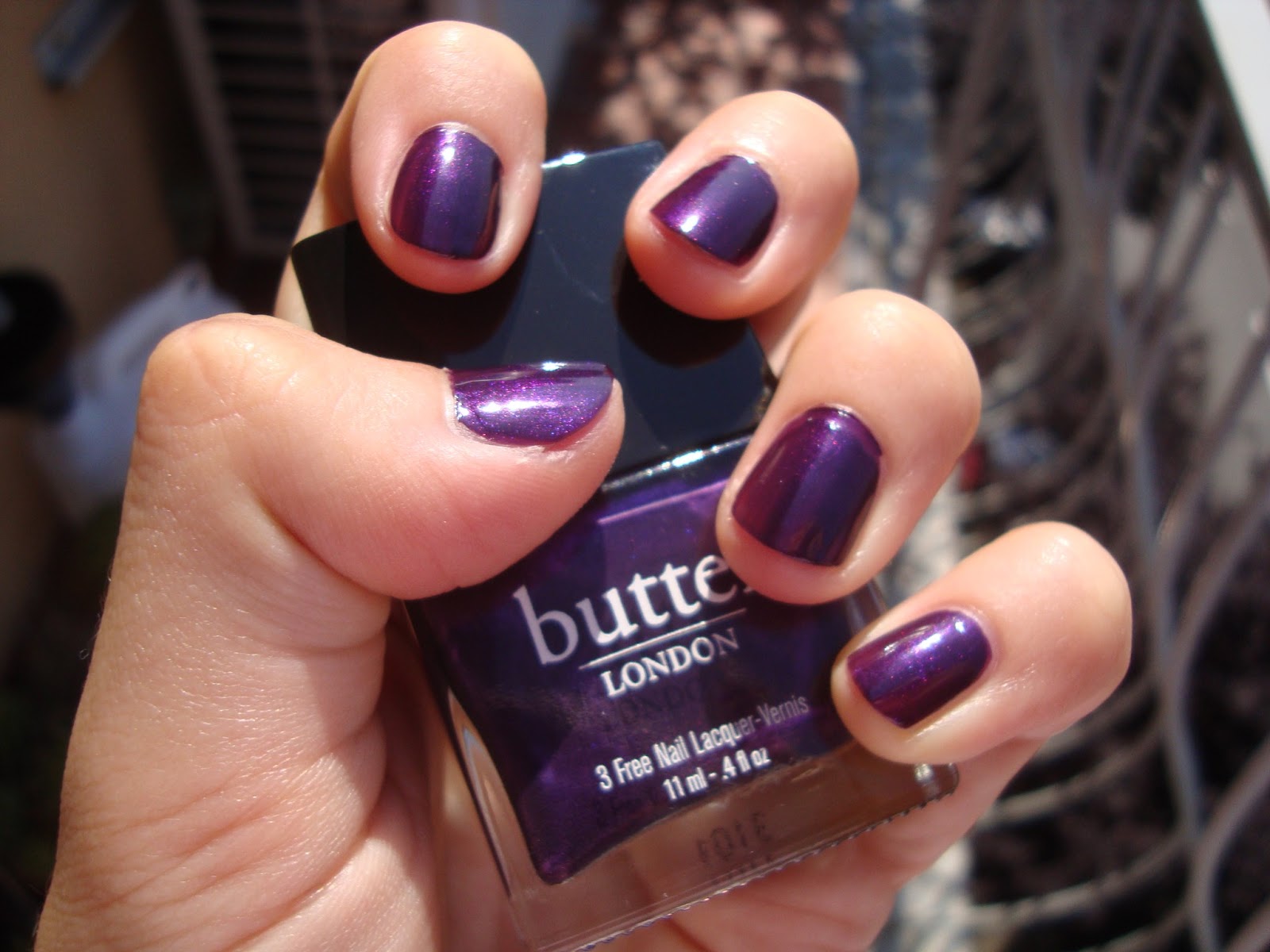
First to jump on the Royal Baby frenzy bandwagon was British brand Butter London, which on 25 April launched its brand new limited edition Pitter Patter Nail Lacquer, described on the website as an opaque aubergine shimmer.
 
 
Butter London Facebook page.


I got mine from US-based website GBS Beauty, and it's a very pretty colour, probably more suited to the winter months, as I like brighter colours on my nails in the summer, but the subtle purple shimmer gives a nice depth to it and I predict I'll get a lot of wear out of it come autumn!

Pitter Patter is also available as part of "The Royals Collection", a set of three, together with Lilibeth's Jubilee, which was first released last year as part of the Diamond Jubilee celebrations, and No More Waity, Katie, which celebrated the engagement between the Duke and Duchess of Cambridge.


Butter London website.
 
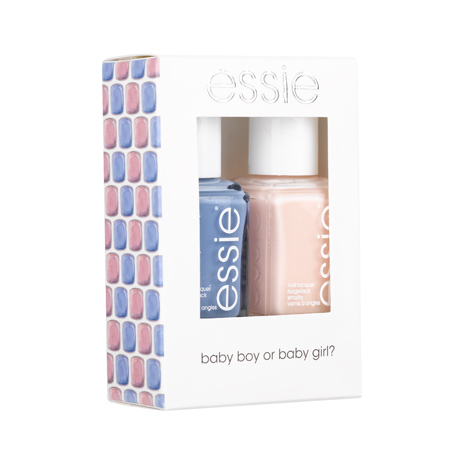
American nail care company Essie also launched a celebratory limited edition nail polish duo kit, comprising a bottle of baby blue Lapiz of Luxury and a bottle of pale pink Muchi Muchi, for "Baby Boy Or Baby Girl?" as the box suggests.
 
Baby duo
Bestdaily.co.uk

And last of all, I would like to share with you the idea I came up with for a personalised Royal Baby manicure I did for myself today. I alternated candy pink (Dior Vernis #155 Tutu) and baby blue (Pupa Lasting Color #745 Pearly Light Blue), as of course the baby's sex is yet unknown, and completed the look with a hand-drawn Union Jack on the left middle finger and a tiny crown, with all the details, including an ermine trim and a purple velvet cap, on the left ring finger.

 
Detail of the nail art.

The whole look.

I'm very proud of my new mani and can't wait to show it off! OK, my working environment is rather conservative, but I guess my colleagues will just have to put up with my nails while Royal Baby fever is upon us :)
What do you think? Will you be painting your nails a special celebratory colour?